What is an Air Actuator and How Does It Work?
Air actuators play a crucial role in various industries, enabling efficient automation and control. These devices convert compressed air into mechanical motion, driving numerous applications. According to a recent report from MarketsandMarkets, the air actuator market is projected to grow significantly, highlighting its importance in aerospace, automotive, and manufacturing sectors.
The functionality of an air actuator relies on its simplicity and reliability. It operates through the control of air pressure, allowing precise movements. This mechanism has proven essential in robotic systems and conveyor lines. Engineers often prefer air actuators for their lightweight nature and ease of maintenance.
However, not all applications benefit equally from air actuators. Their performance may be affected by environmental factors. In areas with extreme temperatures or contamination, air actuators may underperform. Understanding these limitations is vital for optimizing their use. Recent studies emphasize the need for ongoing research to enhance their efficiency and adaptability in various settings.
What is an Air Actuator?
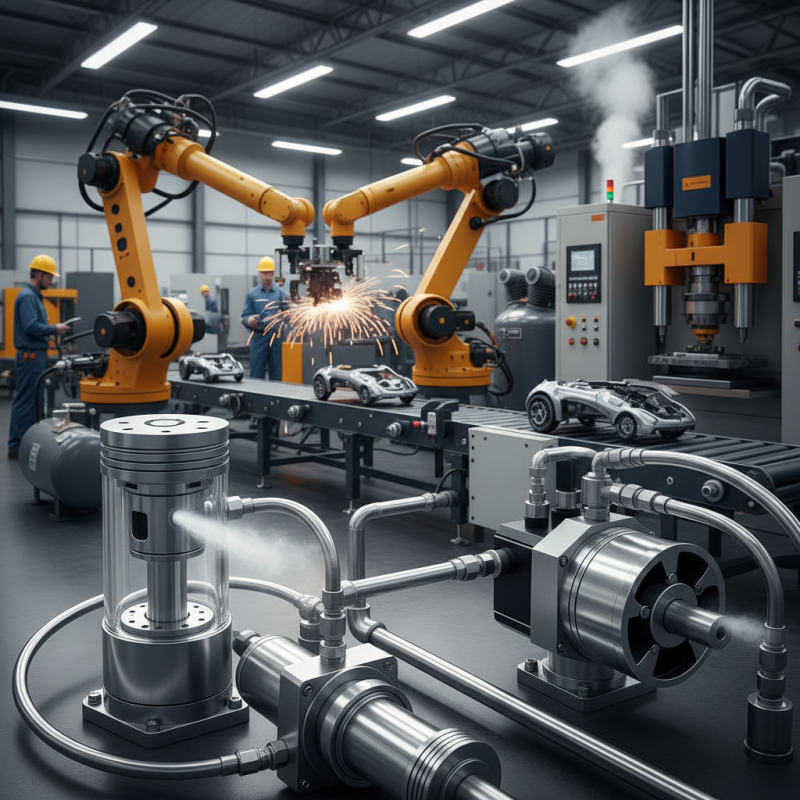
Air actuators are pivotal components in automation and control systems. They utilize compressed air to initiate movement and perform tasks. This technology plays a crucial role in various industries, including manufacturing, aerospace, and automotive. According to a report by Allied Market Research, the global pneumatic actuator market is expected to reach $8.29 billion by 2026, highlighting its growing importance.
These actuators convert air pressure into linear or rotary motion. They often consist of a cylinder, a piston, and a drive mechanism. When air enters the cylinder, it forces the piston to move. This action translates into mechanical force, which can open valves or operate machinery. Industry data shows that pneumatic actuators are favored for their simplicity and reliability. However, they can be less efficient than electric actuators under certain conditions, leading to discussions on improving energy consumption.
Despite their advantages, air actuators can face challenges. The need for a consistent air supply can be a limitation in certain environments. Additionally, contaminants in the air supply can lead to failures. Maintenance is crucial for optimal performance. Regular checks can help ensure longevity. Innovations in air actuator design continue to emerge. As technology evolves, so does the potential for enhanced performance and efficiency.
Air Actuator Performance Characteristics
Key Components of an Air Actuator
Air actuators are vital in automation, especially in industrial applications. They convert compressed air into mechanical motion. Understanding their key components can enhance efficiency and reliability.
One important component is the diaphragm. It responds to air pressure changes, creating movement. A report by the International Society of Automation states that over 30% of industrial automation failures result from actuator issues. Thus, ensuring diaphragm quality is critical.
Another essential part is the cylinder. Cylinders house the diaphragm and determine the actuator's force output. Their size and design influence the actuator's performance. Research indicates that optimal cylinder design can improve the overall lifespan of the actuator by 25%. However, improper sizing often leads to inefficiencies, demanding careful consideration during the selection process.
The control system also plays a crucial role. It regulates air supply and pressure, impacting the actuator's response time. According to a recent study by the Automation Federation, effective control systems can enhance process precision by 40%. Yet, many installations overlook this factor, leading to potential operational inconsistencies.
How Air Actuators Operate Mechanically
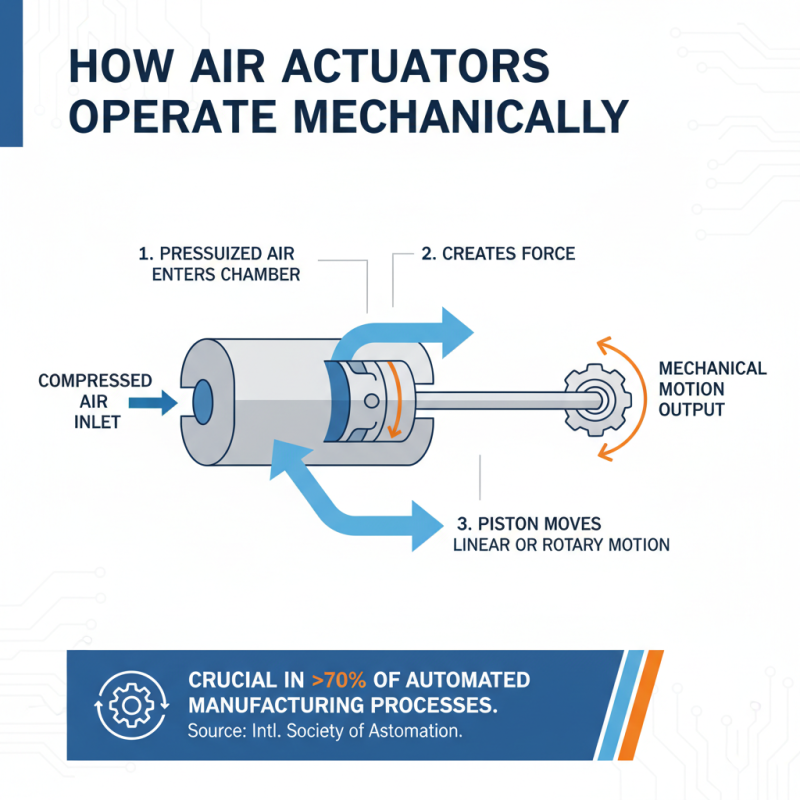
Air actuators play a crucial role in various industrial applications, providing a reliable means of converting compressed air into mechanical motion. They operate based on the principles of pneumatic technology, where the pressurized air is directed into a chamber. This action creates force, moving a piston or diaphragm, which translates into linear or rotary motion. According to a report by the International Society of Automation, air actuators are essential in more than 70% of automated processes in manufacturing environments, highlighting their significance.
The mechanical operation of air actuators is straightforward yet effective. When air enters the actuator, it fills a cylinder, pushing the piston. This results in a precise movement that can be controlled dynamically by adjusting the airflow. The response time of these actuators can be remarkably fast, often within milliseconds. However, they do have limitations—such as requiring regular maintenance to prevent leaks and ensure efficiency. A study from the National Institute of Standards and Technology emphasizes that leaks in pneumatic systems can result in energy losses exceeding 30%, impacting overall productivity.
Additionally, air actuators rely heavily on the air quality and pressure levels. Contaminants in compressed air can affect performance, leading to increased wear and failure rates. It's vital to consider factors like filtration and moisture control in air systems to enhance actuator longevity. Such elements must be assessed to ensure reliability in critical applications.
Applications of Air Actuators in Industry
Air actuators are essential components in various industrial applications. They convert compressed air into mechanical motion. This functionality is widely used in sectors such as manufacturing, automotive, and robotics. According to a report by the International Society of Automation, the global market for pneumatic actuators is projected to reach $12 billion by 2025. This growth reflects the increasing reliance on air actuators for automation and efficiency.
One prominent application is in assembly lines. Air actuators enable precise movements and can handle heavy loads. For instance, they are responsible for lifting, pushing, and rotating parts during manufacturing. This leads to higher productivity and reduced operational costs. In the automotive industry, these actuators enhance the efficiency of robotic arms. They can perform repetitive tasks with accuracy, which minimizes errors and product defects.
Moreover, air actuators are utilized in the packaging industry. They automate the filling, sealing, and labeling processes. This can significantly speed up production rates. A study indicated that companies adopting air actuation have seen efficiency improvements of up to 30%. However, it is vital to monitor their performance. Issues like air leaks can hinder efficiency. Regular maintenance is essential for optimal operation. Manufacturers must balance automation with effective upkeep to avoid mitigating their gains.
Advantages and Disadvantages of Using Air Actuators
Air actuators are widely used in various industries. They convert air pressure into mechanical action. This mechanism allows for smooth movement in automated systems. However, there are advantages and disadvantages to consider when using air actuators.
One advantage is their simplicity. Air actuators typically have fewer moving parts. This can lead to lower maintenance costs. According to a report from the International Society of Automation, air actuators can improve operational efficiency by up to 30%. They are also lightweight, making them easy to install and reposition. Many industries, including manufacturing and automotive, benefit greatly from this technology.
On the downside, air actuators can be less efficient than electric actuators. They require a constant supply of compressed air, which can be costly. A study from the Energy Insights Group indicated that operating compressed air systems can account for up to 30% of a facility's energy bill. Additionally, air actuators may not provide the precise control needed for sensitive applications. This limitation could potentially lead to product variability in the manufacturing process. These factors warrant careful consideration when choosing air actuators for specific applications.
What is an Air Actuator and How Does It Work? - Advantages and Disadvantages of Using Air Actuators
| Feature |
Description |
| Definition |
An air actuator is a device that uses compressed air to create motion or control a mechanism. |
| Working Principle |
Air actuators function by converting compressed air energy into mechanical movement, typically using pistons or diaphragms. |
| Advantages |
- High speed operation
- Simple design
- Less maintenance required
- Safe in explosive environments |
| Disadvantages |
- Requires a compressed air source
- Less precise than electric actuators
- Potential for air leaks
- Efficiency can decrease in extreme temperatures |
| Applications |
Commonly used in manufacturing, robotics, automotive systems, and fluid control systems. |
| Types |
- Pneumatic cylinders
- Diaphragm actuators
- Rotary actuators |
| Maintenance Tips |
Regularly check for air leaks, keep the air supply clean, and lubricate components as needed. |