
Blog
10 Tips for Buying a Vehicle Wedge Barrier
Buying a Vehicle Wedge Barrier is not simply a matter of choosing the tallest steel plate. It is a risk, engineering, and lifecycle decision. A busy hospital entrance needs different protection from a warehouse gate or government facility. Traffic speed, vehicle mass, attack direction, soil conditions, drainage, and emergency access all matter.
Industry guidance supports a careful approach. ASTM F2656 and IWA 14-1 define vehicle-impact testing methods and performance classes. They help buyers compare penetration distance, vehicle type, and test speed. The U.S. Cybersecurity and Infrastructure Security Agency also promotes layered physical security rather than relying on one device. Market reports from Grand View Research and MarketsandMarkets identify continuing investment in perimeter security, driven by infrastructure protection and access-control upgrades. Yet market growth does not guarantee a suitable product. Specifications can look impressive on paper.
Security expert Bruce Schneier’s widely cited statement is useful here: “Security is a process, not a product.” That principle fits every Vehicle Wedge Barrier project. Ask for independent crash-test evidence, not only a brochure claim. Check hydraulic performance during cold mornings and heavy rain. Confirm whether the wedge returns safely after impact. Review warning lights, loop detectors, manual release, maintenance access, and spare-part availability. Small details become expensive later. Sometimes, the cheapest quotation is the least economical choice.
This guide presents ten practical tips for comparing barriers, suppliers, testing records, and installation conditions. It also admits an uncomfortable point: no barrier removes every risk. Good decisions reduce exposure, support controlled movement, and remain workable for people using the site every day.
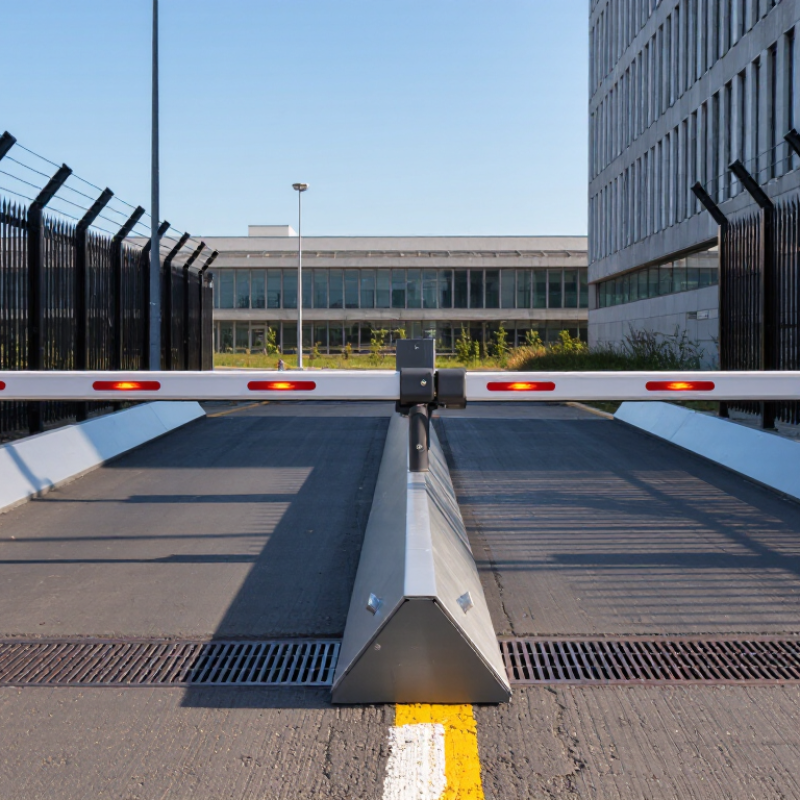
Understanding Vehicle Wedge Barrier Types and Security Functions
10 Tips for Buying a Vehicle Wedge Barrier
Vehicle wedge barriers differ in structure, depth, and operating purpose. Fixed wedges provide constant protection. Retractable models control authorized traffic. Shallow-mount designs suit sites with limited excavation space, but they may offer less structural depth. Hydraulic systems support heavy-duty cycles. Electromechanical systems can simplify maintenance. Check the barrier’s tested vehicle mass, impact speed, and penetration rating under ASTM F2656-23. Do not compare ratings by appearance alone. The U.S. National Institute of Building Sciences stresses that standoff distance and site layout affect vehicle attack resistance. The barrier is only one layer.
Security functions extend beyond stopping a vehicle. A suitable wedge should manage entry lanes, protect pedestrians, and support emergency access. Confirm response time, warning lights, drainage, anti-trip edges, and manual override access. Ask whether the system remains secure during power loss. Review maintenance intervals and replacement-part availability. The National Insurance Crime Bureau’s 2024 Hot Wheels report recorded 1,020,729 vehicle thefts in the United States during 2023. That figure does not define a barrier’s performance, but it reinforces the need for controlled vehicle movement and dependable access records.
Site experience matters. Measure soil conditions, lane width, turning paths, and daily traffic volume before buying. A deep wedge may perform strongly, yet construction can disrupt operations. A shallow model may install faster, but its limits deserve honest review. I would request independent test documents, not only sales claims. Check operator training, inspection logs, and water protection. Even a certified barrier can fail when sensors are misaligned or procedures are ignored. Real security is less impressive than advertised. It is usually more practical.
10 Tips for Buying a Vehicle Wedge Barrier - Understanding Vehicle Wedge Barrier Types and Security Functions
| Tip | Buying Dimension | Vehicle Wedge Barrier Type or Feature | Relevant Data or Benchmark | Security Function | What to Verify Before Purchase |
|---|---|---|---|---|---|
| 1 | Define the required threat level | Crash-rated wedge | ASTM F2656 vehicle-impact ratings commonly identify tested impact speeds such as M30, M40, and M50, corresponding to 30, 40, and 50 mph test speeds. Penetration distance is reported separately. | Stops or significantly slows an unauthorized vehicle after a controlled impact. | Request the complete, current impact-test report for the exact barrier configuration, including the vehicle class, impact speed, penetration rating, foundation, and installation method. |
| 2 | Choose the correct wedge configuration | Rising wedge | Wedge barriers are available in fixed and retractable forms. Retractable models lower into the roadway to permit authorized traffic and rise to create a physical obstruction. | Provides a high-strength vehicle obstacle while maintaining controlled roadway access. | Confirm whether the site needs a fixed barrier, shallow-mount retractable barrier, or deep-mount retractable barrier based on traffic flow and excavation limits. |
| 3 | Match foundation depth to site conditions | Shallow-mount or deep-mount | Shallow-mount systems reduce excavation depth but may require stronger structural coordination with the pavement and reinforced foundation. Deep-mount systems generally require more excavation and drainage planning. | Transfers impact forces into the foundation and surrounding pavement. | Obtain foundation drawings, required concrete strength, reinforcement details, drainage requirements, groundwater limitations, and finished-road elevation tolerances. |
| 4 | Select suitable operating speed | Hydraulic, electromechanical, or pneumatic drive | Opening and closing times vary by design, barrier length, control system, temperature, and safety settings. The advertised cycle time should be treated as a product-specific value, not a universal standard. | Controls how quickly a lane can be secured or reopened during normal and emergency operations. | Compare full open-close cycle time, duty cycle, motor or pump rating, emergency operation, and performance under the site's expected temperature range. |
| 5 | Check lane width and vehicle geometry | Single-lane or multi-lane wedge | Barrier width must match the clear roadway width while allowing safe edge clearances, drainage, maintenance access, and the required approach alignment. | Prevents vehicles from bypassing the protected point at the sides of the barrier. | Measure lane width, curb locations, turning paths, shoulder conditions, and possible bypass routes. Confirm the tested width matches the proposed installation width. |
| 6 | Review load and environmental requirements | Traffic-rated deck and structure | When lowered, the barrier may need to withstand routine vehicle loads. The required load depends on vehicle type, axle arrangement, speed, and local road design criteria. | Maintains safe operation when authorized vehicles pass over the retracted barrier. | Verify rated wheel load or axle load, deck plate thickness, anti-slip surface, drainage, corrosion protection, snow or ice conditions, and flood exposure. |
| 7 | Integrate access control correctly | Access-control interface | Common interfaces include card readers, RFID systems, vehicle identification, intercoms, ticketing systems, traffic signals, and security management platforms. | Allows only authorized vehicles to pass and creates an auditable access event. | Confirm input and output types, relay or network compatibility, fail-safe logic, anti-tailgating controls, event logging, and manual override procedures. |
| 8 | Prioritize pedestrian and vehicle safety | Safety detection package | Typical protective devices include loop detectors, photoelectric sensors, radar, warning lights, audible alarms, obstruction detection, and emergency stop controls. | Reduces the risk of the wedge moving while a vehicle, person, or object occupies the danger zone. | Check detection coverage, warning duration, safety-edge performance, emergency stop response, reset procedure, and compliance with applicable electrical and machinery rules. |
| 9 | Plan power-loss and emergency operation | Manual release or backup power | Emergency options may include a manual hydraulic hand pump, mechanical release, battery backup, generator connection, or controlled lowering system. | Maintains evacuation, emergency access, and controlled site security during a utility failure. | Define the required power-loss position, recovery time, manual operating effort, battery autonomy, emergency access authority, and post-failure reset process. |
| 10 | Evaluate lifecycle cost and maintainability | Serviceable modular system | Lifecycle cost includes civil works, electrical installation, drainage, inspections, replacement parts, preventive maintenance, testing, and downtime—not only the purchase price. | Preserves reliable security performance and reduces the chance of an unplanned open or closed condition. | Request maintenance intervals, inspection checklists, spare-parts availability, warranty terms, corrosion-protection details, training requirements, and documented service procedures. |
Note: Impact ratings, dimensions, operating speeds, foundation requirements, and load capacities are configuration-specific. Always confirm the values in the manufacturer's certified documentation and the project engineer's site design.